
5 Things to Know About Owning a Country Property
There is something special about country living in Grey County.
More space. More privacy. Quieter mornings. Darker night skies. Room for gardens, workshops, trails, pets, family gatherings and a different pace of life.
For many buyers, owning a country property in Grey County is the dream. It offers the kind of lifestyle that is getting harder to find: fresh air, open views, mature trees, nearby lakes, charming small towns and four-season recreation close to home.
But country properties are different from in-town homes.
They often come with private services, larger lots, outbuildings, longer driveways, rural zoning considerations and maintenance responsibilities that may be new to buyers moving from a town, subdivision or city.
None of this should scare you away. In fact, for the right buyer, these are often part of the appeal. But it is important to understand what you are buying, what to ask, and what to look into before making a decision.
Here are five important things to know before buying or owning a country property in Grey Highlands, West Grey or anywhere in rural Ontario.
1. Your Water Source Matters
Many country homes in Grey Highlands are serviced by a private well rather than municipal water.
That means the homeowner is responsible for understanding where the water comes from, how the system works and whether the water is safe to drink.
A well can be a very reliable source of water, but it should be treated as an important part of the property.
Before buying, it is wise to ask questions such as:
- Is the property serviced by a drilled well, dug well, shore well, cistern or another water source?
- Where is the well located?
- Is there a well record available?
- Has the water been tested recently?
- Are there treatment systems in place such as a UV light, sediment filters, softeners or reverse osmosis?
- Has the well ever run low?
- Does the water have odour, staining, hardness or mineral issues?
In Ontario, private well owners can access free bacterial water testing through Public Health Ontario. This tests for indicators such as E. coli and total coliforms, which can help identify potential bacterial contamination. You can learn more through Public Health Ontario’s private well water testing program.
It is also important to understand what a standard bacterial test does not cover. It typically does not test for minerals, metals, hardness, sulphur, sodium, nitrates or other chemical concerns. If those are a concern, additional testing through a licensed laboratory may be appropriate.
For buyers, a water potability test is common, but it should not be the only question. A good country property review should also consider water quantity, system age, treatment equipment and the general condition of the well area.
A well that is properly located, protected and maintained can serve a property well for many years. But like anything else on a country property, it should not be ignored.
2. Septic Systems Need Care and Understanding
Most rural properties outside municipal servicing areas use a private septic system. That’s not necessarily a problem. In fact, many work very well for decades when properly installed and maintained but buyers need to understand that a septic system is a private sewage treatment system, and the homeowner is responsible for its use, care and repair.
A typical septic system includes a tank and a leaching bed. Wastewater from the home flows into the tank, solids settle, and liquid moves out to the leaching bed where it is filtered through the soil.
When looking at a country property, ask:
- Where is the septic tank located?
- Where is the leaching bed?
- How old is the system?
- Is there a septic use permit, installation record or inspection paperwork?
- When was the tank last pumped?
- Has the system ever backed up?
- Are there signs of wet areas, odours or lush grass over the bed?
- Has the home had additions that may have changed bedroom count or usage?
Ontario has helpful general information about septic systems through the province’s septic systems resource page.
It is also important to remember that septic capacity is often tied to the size and design of the home, including bedroom count. If you are thinking about adding bedrooms, finishing a basement, building an addition or converting a seasonal cottage to more regular use, the septic system may need to be reviewed.
Good everyday habits also matter. Avoid flushing wipes, grease, harsh chemicals or anything that can interfere with the system. Be mindful of heavy water use. Do not drive over or build on the leaching bed. Keep trees with aggressive roots away from the system.
For buyers, a septic inspection can provide valuable peace of mind. At minimum, you should understand what documentation exists and whether the system appears appropriate for the home and property.
3. Zoning and Conservation Rules Can Affect What You Can Do
One of the biggest mistakes buyers make with country properties is assuming that because there is land, they can do whatever they want with it. In rural Ontario, every property is subject to zoning which can affect permitted uses, building setbacks, accessory structures, home occupations, livestock, short-term rentals, additional residential units, lot coverage and more.
In Grey Highlands and the surrounding area, zoning can vary widely from one property to another. A property may be rural, agricultural, hazard, environmental protection, residential, commercial or subject to site-specific provisions. The rules can be very different depending on the exact zoning and location.
Before buying a property, especially if you have future plans, it is worth asking:
- What is the current zoning?
- Are the buildings and uses permitted?
- Are there any environmental protection or hazard areas?
- Are there limitations on additions, garages, shops or barns?
- Can animals or livestock be kept on the property?
- Are there restrictions affecting home-based businesses or rental uses?
- Is the property subject to conservation authority regulation?
The Municipality of Grey Highlands provides zoning information through its website, including details about how zoning regulates the use, size, height, density and location of buildings. You can start with the municipal Grey Highlands zoning page.
Some properties may also fall within areas regulated by a conservation authority, especially near wetlands, watercourses, slopes, floodplains or other natural features. In much of this area, that may involve the Grey Sauble Conservation Authority. Their website provides information about planning and permit applications and regulated areas.
This does not mean you cannot improve or enjoy the property. It simply means you should know the rules before assuming any future projects will be straightforward.
For example, buyers may want to:
- Build a large detached shop
- Add a garden unit or 2nd residence for extended family
- Create a short-term rental
- Keep horses or livestock
- Add or change a pond
- Build near a creek or ravine
- Sever a lot
- Expand a cottage or alter the shoreline
- Run a business from home
Each of these ideas may be possible in some situations and difficult or restricted in others. A good local Realtor® can help you identify which questions to ask before you get too far into the process.
4. Driveways, Snow, Trees and Outbuildings Are Part of the Lifestyle
Country properties often come with more land, and with that comes more maintenance. For many people, that is part of the appeal. There is room to breathe, space to spread out and the satisfaction of caring for your own piece of Grey County.
But it is still important to be realistic.
A long driveway is beautiful in the fall. It may also need plowing all winter. Mature trees add privacy and character. They may also require trimming, cleanup or occasional removal. Outbuildings provide storage, workshop space and flexibility. They may also need roofs, siding, hydro upgrades, doors, drainage, grading or foundation attention. Lawns and gardens can be a joy. They can also take time, equipment and planning.
Before buying, think about how you will use and maintain the property in all four seasons.
Ask yourself:
- How will you clear snow from the driveway? Can you do it yourself with a snowblower or will you need to hire someone with a plow?
- Is there room to turn vehicles around in winter?
- Are there trees close to the house, septic bed, driveway or hydro lines?
- Is the lane steep, shaded or prone to drifting?
- Are the outbuildings insured, permitted and in usable condition?
- Is there adequate drainage around the home and structures?
- Will you need a tractor, riding mower, snowblower or generator?
- Is there reliable internet for work, streaming and everyday use?
Internet is especially important. Rural service has improved significantly in many parts of Grey County, but availability can still vary from road to road. Some properties have fibre or cable. Others rely on wireless, satellite or other rural options like pier-to-pier. Never assume service is the same just because a nearby property has it.
Country living is not just about the house. It is about the whole property.
The happiest buyers are the ones who fall in love with the lifestyle while also understanding the practical side of ownership.
space
5 Things You Need to Know About Owning a Country Property
5. Rural Homes Reward Buyers Who Look Beyond the Surface
Country properties are rarely cookie-cutter. That is one of the reasons they are so appealing.
You may find century farmhouses, renovated schoolhouses, country bungalows, rural subdivisions, waterfront cottages, chalets, hobby farms, log homes and newer custom builds tucked into the landscape.
But because each property is different, buyers need to look carefully. A polished kitchen and beautiful view are wonderful, but they are only part of the story.
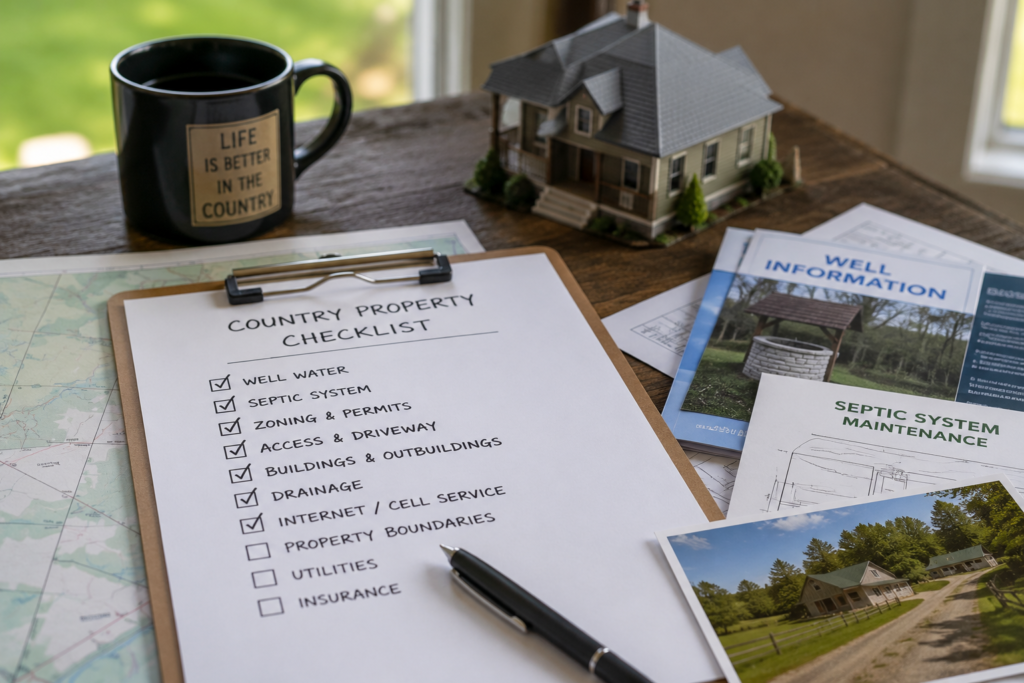
With rural homes, it is just as important to understand the fundamentals:
- Foundation
- Roof
- Heating system
- Electrical system
- Plumbing
- Insulation
- Windows
- Well
- Septic
- Drainage
- Access
- Zoning
- Internet
- Outbuildings
- Long-term maintenance
Older homes can have incredible charm and character, but they may also have layers of renovations from different decades. Some updates may be cosmetic. Others may be significant. It is important to understand the difference.
Heating is another key consideration. Rural homes may use propane, oil, wood, electric baseboards, heat pumps, geothermal or a combination of systems. Each has different operating costs and maintenance requirements.
The same goes for insurance. Some rural properties may require additional information before insurance can be arranged, especially if there are wood stoves, older wiring, outbuildings, vacant structures, waterfront exposure or hobby farm uses.
A thorough home inspection is often valuable, but so is local experience. Someone familiar with rural Grey County properties will know the types of questions that commonly come up on rural roads, older farmhouses, recreational properties and country homes.
The goal is not to find reasons not to buy. The goal is to buy with confidence.
When you understand the property properly, you can make better decisions, plan for future improvements and enjoy the home for what it is.
5 Things to Know About Owning a Country Property
The Reward: A Lifestyle That Is Hard to Match
Owning a country property in Grey County is about more than square footage and lot size.
It is morning coffee on the porch and listening to the birds instead of the traffic.
Having enough space for family and friends.
Enjoying gardens, trails, campfires and quiet evenings.
Being close to places like Lake Eugenia, Beaver Valley, the Bruce Trail, Markdale, Flesherton, Kimberley, Feversham and the surrounding countryside.
It is a lifestyle that feels peaceful, practical and connected to nature.
For some people, town living is the right fit. For others, a country property offers exactly the kind of life they have been looking for.
The key is knowing what you are buying.
When you understand wells, septic systems, zoning, maintenance and the unique character of rural homes, you are much better prepared to choose the right property and enjoy it for years to come.
Thinking About Buying or Selling a Country Property in Grey Highlands?
At Forest Hill Real Estate – Grey County, we live and work in the communities we serve. We understand the difference between an in-town home, a rural subdivision, a country retreat, a farm property, a waterfront cottage and a recreational escape.
If you are thinking about buying or selling a country property in Grey Highlands, West Grey, Chatsworth, Southgate or any of the small towns, villages and hamlets in Grey County, we would be happy to help you understand the market, the lifestyle and the important details that come with rural ownership.